
How to Stop Gambling
You've probably already tried. Deleted the apps. Promised. Made it eleven days once. So this page won't insult you with "just set a budget!" — it's the actual playbook, in the order that works, including the part most sites bury: what to do when the playbook alone isn't enough. Everything here is usable today, whether or not you ever contact us.
First, Understand What You're Actually Fighting
Not weakness — three machines running at once. Willpower addresses none of them. Structure addresses all of them.
The Reward Schedule
A variable reward schedule engineered to be habit-forming — unpredictable payouts at unpredictable intervals.
The Cognitive Distortions
Chasing, "I'm due," the illusion of control — thinking traps that feel like logic from the inside.
The Engine Underneath
For most people, an anxiety, depression, or stress engine the gambling has been quietly medicating.
Willpower addresses none of the three. Structure addresses all of them. That's the theme of every step below.
Step 1 — Make the Next Bet Harder Than the Urge Is Long
Urges crest and fall — typically within 20–30 minutes if not fed. Every barrier that adds friction longer than that wins by default:
Blocking Software:
install a dedicated gambling blocker (Gamban and BetBlocker are the established options; BetBlocker is free) on every device — phone, tablet, laptop, work computer. Have someone else set the uninstall password.
Self-Exclusion:
Enroll in California's self-exclusion programs for the venues you use — and know the honest limit: exclusion lists don't reach offshore sportsbooks, sweepstakes casinos, or gray-market apps, which is exactly why blocking software and financial guardrails matter more in California than almost anywhere.
Kill The Frictionless Money:
Delete saved cards from every platform, remove betting apps' access to Apple Pay/Google Pay, unsubscribe from every sportsbook and casino email and text ("STOP" to all of them), and turn off score/odds notifications.
Step 2 — Put the Money Behind Glass
Financial guardrails aren't about distrust of yourself; they're about respecting how fast an urge moves.
- A trusted person with visibility into (or temporary control of) accounts.
- A bank that lets you block gambling merchant codes on your cards (many now do — ask).
- No standing cash beyond the day's needs.
- Direct deposit rearranged so the bulk lands where impulse can't reach it same-day.
If gambling has already created real debt, that's repairable with structure — and it's a core module of treatment, not a shame sentence.
Step 3 — Build the 30-Minute Urge Plan (write it down tonight)
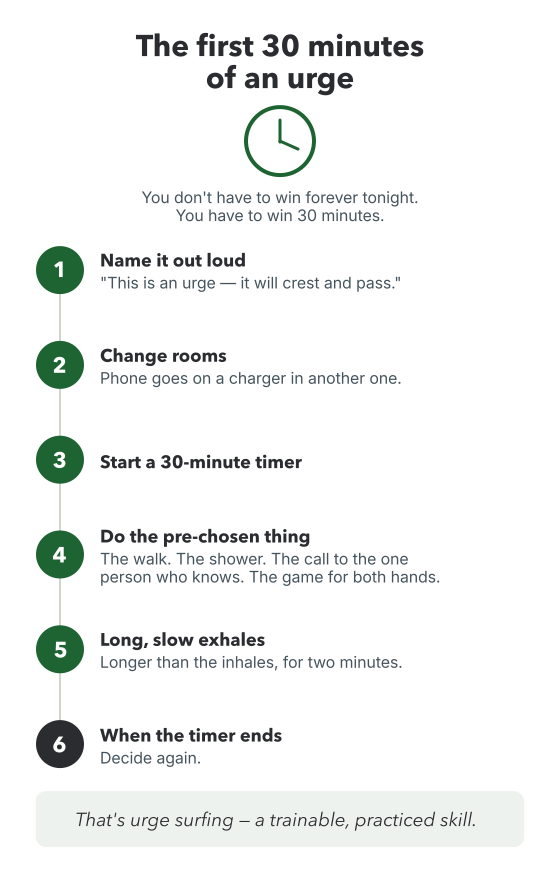
When the urge hits:
- Name it out loud — "this is an urge, it will crest and pass."
- Change rooms; phone goes on a charger in another one.
- Start a 30-minute timer.
- Do the pre-chosen thing — the walk, the shower, the call to the one person who knows, the game that occupies both hands.
- Long exhales, longer than the inhales, for two minutes.
- When the timer ends, decide again.
You don't have to win forever tonight; you have to win 30 minutes. That's urge surfing, and it's a trainable skill — in structured treatment it gets practiced and debriefed the same week.
Step 4 — Replace What Gambling Was Doing
The empty slot matters as much as the removed habit. Gambling was providing something — excitement, escape, focus, a pulse, social identity. List what it did for you, honestly, then schedule replacements that hit the same need:
- Intensity needs intensity (training, competition, cold water, live events)
- Escape needs absorption (not more screens with odds on them)
- Connection needs rooms with people in them.
This is behavioral activation, and it's the difference between quitting into a void and quitting into a life.
Step 5 — Tell One Person
Secrecy is the disorder's load-bearing wall. One honest conversation — chosen person, chosen time, no ambush of yourself — cuts the structure. If the full conversation is too much yet, the helpline is a rehearsal space: free, confidential, 24/7.
Step 6 — Know the Honest Line Between Self-Help and Treatment
Everything above works — and for milder patterns it's often enough. Here's the line, drawn plainly:
- You've run these steps before and the gambling keeps coming back.
- The urges are daily.
- There's real financial damage or a relationship on the line.
- Anxiety, depression, or trauma is underneath the betting.
Then the loop has more momentum than tools alone can hold, and that's not a verdict on you; it's dosage. Fewer than one in ten people with a gambling problem ever get professional help, and it isn't because the other nine succeeded alone. Structured treatment exists precisely for the pattern that survives self-help:
What treatment involves at every level →
Our virtual gambling IOP, if the momentum is real →
Five-minute check on where you actually stand →
Frequently Asked Questions
Can I stop gambling cold turkey?
You can stop abruptly — there's no medical danger in stopping gambling the way there can be with some substances — but expect real restlessness, irritability, and sleep disruption for days to weeks; that agitation is a documented feature of the disorder, not a sign you "need" gambling. The steps above exist to hold the line through it.
How long do gambling urges last?
Individual urges typically crest and pass within 20–30 minutes unfed. Frequency declines over weeks and months — with spikes around paydays, big games, stress, and anniversaries. Plan for the spikes; they're schedulable.
Is there gambling withdrawal?
Restlessness, irritability, low mood, and sleep trouble when stopping are common and real — the DSM criteria literally include restlessness when cutting back. Uncomfortable, temporary, and much more manageable when the mood conditions underneath are being treated too.
What's the best app to block gambling?
Gamban (paid) and BetBlocker (free) are the established dedicated blockers; layer one with your phone's screen-time controls and your bank's gambling-merchant block. No single tool is airtight — stacking is the strategy.
Does self-exclusion work in California?
For the venues it covers, it's a genuinely useful barrier. Its honest limit: offshore books, sweepstakes casinos, and gray-market apps sit outside every exclusion list — in California, blocking software and financial guardrails have to carry more of the load.
Can I ever gamble normally again?
The honest answer: for people who've met criteria for gambling disorder, the evidence and clinical consensus lean strongly toward abstinence as the stable outcome — moderation attempts are where relapses breed, because the machinery (tolerance, chasing, distortions) reactivates fast. That said, this is a question to work through in treatment honestly, not a rule to take on faith from a website.
What if I slip after quitting?
A lapse is not a relapse — unless it has no plan attached. The first hour matters most: tell your person, leave the venue/app, no chasing "since the day's ruined anyway" (that's the abstinence-violation trap), and treat it as data about a trigger. Recovery that has no plan for imperfection isn't a plan.
Do I need treatment or can I do this alone?
Run Step 6's honest line. Milder pattern, first serious attempt, no mood engine underneath: run this playbook hard. Daily urges, repeated failed attempts, real damage, anxiety or depression in the mix: the loop outweighs the toolkit, and matching help to momentum is the intelligent move — not the defeated one.