
Gambling Problem Treatment in California
A gambling problem is a treatable mental health condition — not a character flaw, not a math deficiency, not something you should be able to fix with a spreadsheet and a promise. Clinically it's called gambling disorder, the only behavioral condition of its kind with formal diagnostic criteria in the DSM-5. Between 0.4% and 4% of people experience it in their lifetime — teachers, nurses, retirees, and the guy who never missed a mortgage payment until this year.
This page covers what effective gambling problem treatment involves, which methods have real evidence, the levels of care, and how to tell what you need.
Why a Gambling Problem Doesn't Respond to Willpower
Three mechanisms, none of them weakness.
The reward schedule: gambling pays out unpredictably — variable-ratio reinforcement, the most habit-forming schedule known to behavioral science, and the one slot machines and parlay apps are engineered on.
The thinking traps: chasing losses, "I'm due," the near-miss rush, the illusion of control — documented cognitive distortions that feel like logic from the inside. You can't out-argue a distortion you can't see.
The job it's doing: most people with gambling disorder have at least one co-occurring mental health condition. Remove the gambling without treating the anxiety or depression underneath and you've removed the coping tool and left the pain. That's not recovery — it's a countdown. This is why deleted apps get redownloaded, and why "never again" lasts until payday.
Treatment Methods That Actually Work for a Gambling Problem
Named, in plain English, all used at Reset:
Cognitive behavioral therapy (CBT)
The backbone; protocols developed for gambling and tested in randomized controlled trials. Thought records that catch distortions in real time, supervised practice, urge management.
Motivational interviewing (MI)
Works with ambivalence instead of demanding certainty; why "I'm not sure I want to stop" is a valid starting point.
Relapse prevention (Marlatt model)
Early warning signs, high-risk hierarchies, a written lapse plan; a lapse handled well doesn't become a relapse.
DBT-informed emotion regulation
For the anxiety and low mood the gambling was managing.
Behavioral activation
Rebuilding a week that competes with gambling for excitement, connection, and time.
ACT values work & compassion-focused approaches
The gap between your values and the gambling drives change; the shame work keeps that gap from curdling into self-hatred, which is relapse fuel.
Financial harm reduction
Structured damage assessment, then budgets, transparency, accountability. Two full modules — because financial secrecy is a symptom, not a side effect.
Reviews consistently identify CBT and MI as the approaches with the strongest support.
Is There Medication for a Gambling Problem?
No FDA-approved medication exists specifically for gambling disorder. Medication can help co-occurring depression or anxiety, lowering the pressure driving the betting — coordinated with prescribers when appropriate. The strongest evidence belongs to structured behavioral treatment. Anyone selling a pill for gambling is ahead of the science.
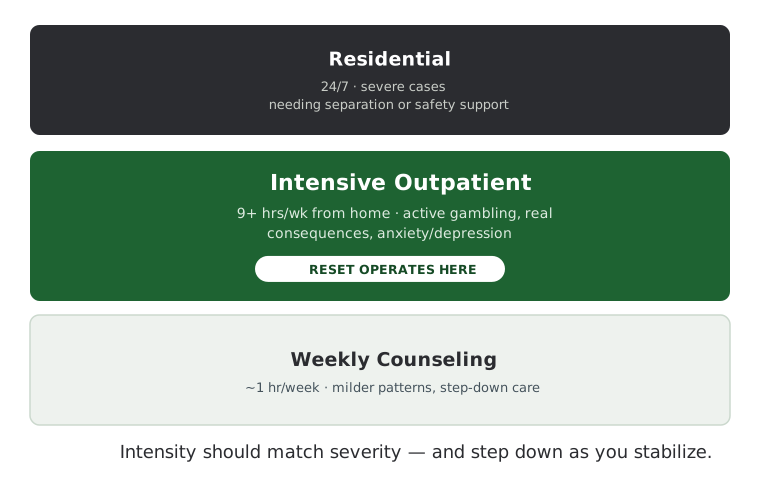
Levels of Care — What's Right for You
Weekly counseling or gambling therapy:
milder patterns, maintenance after intensive care.
IOP:
Active, consequential gambling tangled with mood — our virtual gambling IOP →.
Residential:
Severe cases needing full environmental separation.
In writing:
If the assessment says you need a level we don't provide, we'll say so and help you find it.
Do I Actually Need Treatment?
The DSM-5 defines gambling disorder by nine criteria — preoccupation, betting more for the same excitement, restlessness when cutting back, repeated failed stops, gambling when distressed, chasing losses, lying about it, jeopardizing relationships or work, relying on others for bailouts. Four or more within a year indicates the disorder — and clinically, the dollar amount matters far less than the impact.
What gambling disorder is, in plain English →
Trying to quit on your own first? Start here →
Treating What's Underneath — at the Same Time
Anxiety, depression, and trauma aren't complications of a gambling problem; they're usually the fuel line.
Why Online Gambling Treatment Works — Sometimes Better
Privacy is the top reason fewer than one in ten people with gambling problems ever seek help. No parking lot, no waiting room, no schedule mystery at work. With online gambling participation at 22% of U.S. adults and rising, the phone is where the problem lives — so the phone is where the skills need to work.
Of U.S. adults now gamble online, and rising — up from 15% just a few years ago.
Frequently Asked Questions
Is a gambling problem a real medical condition?
Yes — it's gambling disorder, defined in the DSM-5 by nine formal criteria. What matters diagnostically is impaired control and life impact, not the dollar figure.
Problem gambling vs. compulsive gambling vs. gambling disorder?
Same condition, different vocabularies. "Gambling disorder" is the clinical diagnosis; "compulsive gambling" is the older term (and captures the felt experience — the pull that overrides intention); "problem gambling" is broadest, covering patterns that don't yet meet threshold. Treatment is the same family regardless of label. Most effective treatment for compulsive gambling? CBT built for gambling + motivational interviewing + structured relapse prevention — the strongest trial evidence. Intensity should match severity.
Can it be cured?
Clinicians say remission and recovery, not cure — and lasting recovery is achievable. Anyone guaranteeing a cure is selling something.
How long does treatment take?
Typical IOP episode: 6–12 weeks plus step-down. Severity, co-occurring conditions, and life circumstances move that number; it's reviewed with you throughout.
What's the success rate?
We won't quote a marketing number — outcome statistics vary enormously by how "success" is measured. What research supports: structured treatment meaningfully reduces gambling and gambling harm versus no treatment or willpower alone, and treating co-occurring conditions improves the odds further.
Is there a pill for gambling?
No FDA-approved medication for gambling disorder. Medication can help co-occurring depression or anxiety.
Does insurance cover gambling problem treatment?
Most commercial California plans cover medically necessary IOP-level behavioral health care; specifics vary. Verify yours →
Gamblers Anonymous or treatment?
Not either/or. GA is free peer support, not clinical treatment; step-down planning often includes it, and GA-first-then-treatment is a well-worn path.
Is self-exclusion enough?
Useful layer, not treatment — it restricts access without touching urges, distortions, or mood, and California's gray market (offshore books, sweepstakes casinos) sits outside exclusion lists anyway. Use it and treat the condition. Practical blocking tools →
Can I start treatment without having stopped gambling?
Yes — come as you are. Motivational work with ambivalence is the front door, not a prerequisite.
What if it's my husband or wife who needs this?
Start with our family guide, and call us directly — the admissions line is open to families, including before the person gambling is ready.