
Gambling and Mental Health: One Loop, One Treatment
This page is the philosophy of the whole program, stated plainly: gambling disorder almost never travels alone, and treating it as if it does is why so much treatment fails.
The research is unambiguous — most people with gambling disorder have at least one co-occurring mental health condition, with mood and anxiety disorders the most common companions. That's not a coincidence of unlucky people with two problems. It's one system: the mental health condition supplies the pain, gambling supplies the anesthetic, and the consequences of gambling — debt, secrecy, shame, wrecked sleep, broken trust — resupply the pain. Around the loop again.
The mechanism
The Problem Gambling Loop
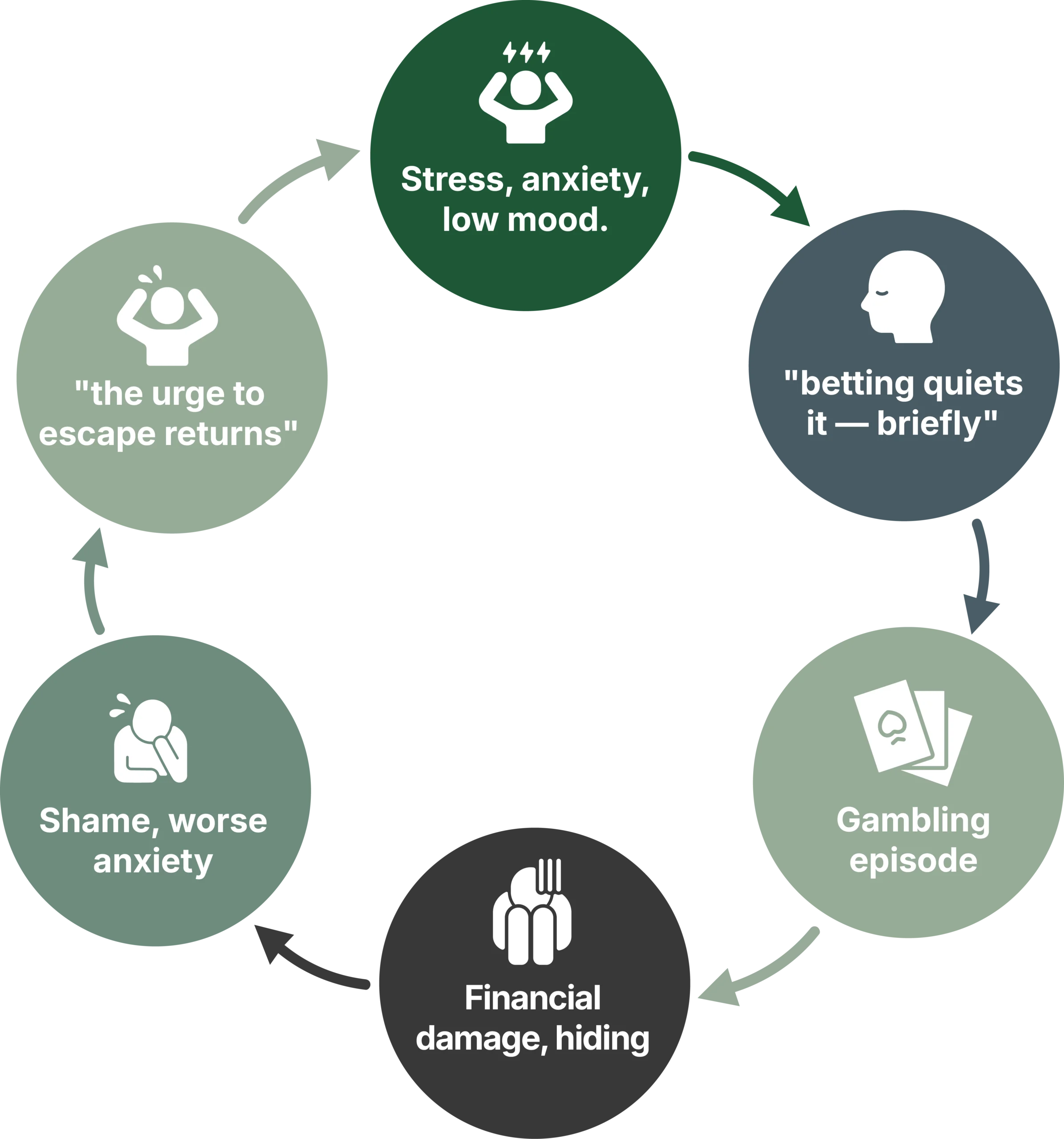
The Loop, Condition by Condition
Anxiety gambles for quiet — the racing mind's fifty tabs closed down to one live bet. The full picture →
Depression gambles for a pulse — signal instead of static when everything's gone flat. The full picture →
Trauma gambles for escape — an on-demand dissociative state for a nervous system stuck on alert. The full picture →
The literature also documents elevated gambling risk with ADHD, bipolar disorder, and high-stress life transitions — different fuels, same engine. If your pattern doesn't match a tidy category, that changes nothing about treatability: the assessment maps your loop, whatever it's made of.
Which Came First Doesn't Decide the Treatment
People burn enormous energy on the origin question — "am I gambling because I'm depressed, or depressed because I'm gambling?"
Clinically useful, not decisive: either direction, both conditions are now real, both are maintaining each other, and both need treatment in the same span of weeks.
Sequential care — "get the gambling handled, then we'll deal with the anxiety" — is how each condition sabotages the other's treatment: the untreated one refills the treated one, month after month.
Restlessness when cutting back and gambling when distressed are written directly into the DSM-5's criteria for gambling disorder — the diagnosis itself assumes the entanglement.
What "Integrated" Actually Means Here
Not two therapists who occasionally email. One program, one curriculum, one team: emotion-regulation and co-occurring modules sit inside the same 24-module rotation as urge management, financial repair, and relapse prevention — built on the treatment approaches with the strongest evidence for gambling disorder.
Your thought records catch "I'm due for a win" and "nothing will ever change" in the same notebook. Your relapse-prevention plan lists the nightmare and the payday as the connected triggers they are. And your group understands both halves of your sentence. What the program looks like week to week →
The Hard Sentence That Belongs on This Page
The collision of gambling losses, hopelessness, and shame carries real risk — including thoughts of suicide. If you're there, the order of operations is simple: call or text 988 first (Suicide & Crisis Lifeline, free, confidential, 24/7), then treatment when you're safe. Despair this specific — "the math is unfixable, everyone would be better off" — is a symptom of two treatable conditions amplifying each other. It reads like a conclusion. It's a symptom. Symptoms respond to treatment.
Frequently Asked Questions
Do I have two diagnoses or one?
Possibly two — gambling disorder plus an anxiety, mood, or trauma-related condition — and the assessment sorts that out. Functionally, you have one loop, and the treatment is built around the loop.
Will I be treated for a condition I don't have?
No. The curriculum flexes to your assessment: everyone gets the gambling work; the co-occurring emphasis follows what's actually present.
What if my mental health condition is something other than anxiety, depression, or trauma?
The assessment covers the full picture. Conditions we treat within the program are treated here; anything needing specialized care beyond IOP scope gets an honest referral and coordination — in writing, that's the promise.
Isn't it better to fix the gambling first and then deal with the rest?
The evidence and our clinical team's experience say no — sequential treatment is how the untreated condition refills the treated one. Integration is the point of this program's design.
Can my regular therapist stay involved?
Yes, with your consent — coordination with existing providers is welcome, and step-down back to your therapist is a common continuing-care plan.
Where do I start?
The self-assessment if you're still mapping the problem; verify insurance or call (866) 291-2204 when you're ready to talk.